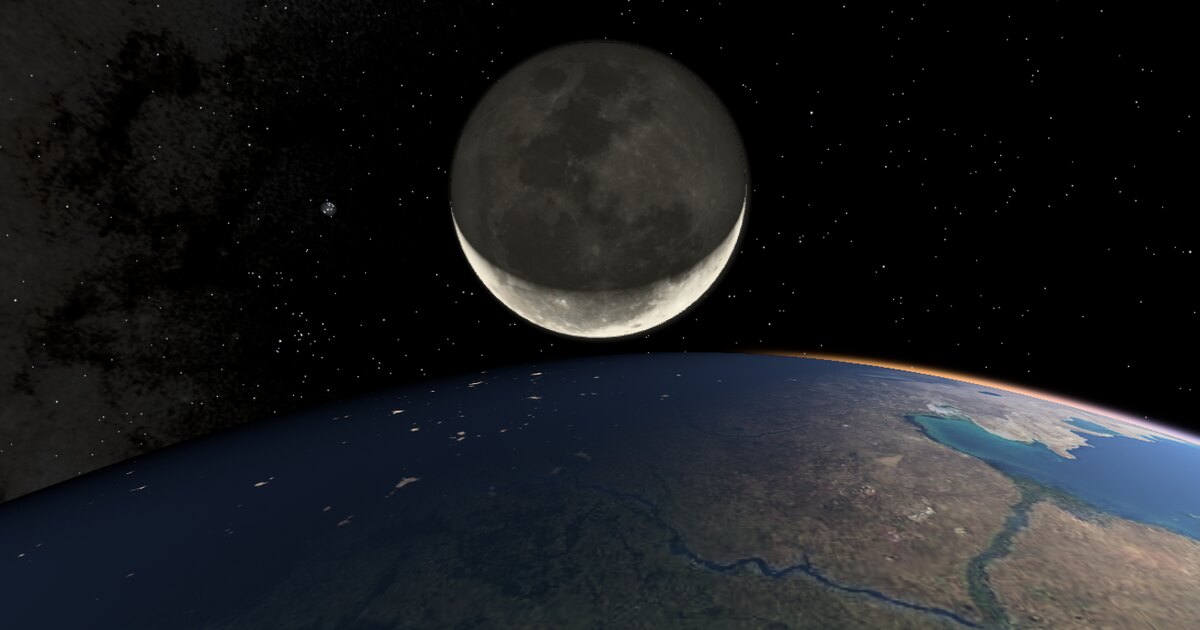
In the summer of 2016 i flew overnight from Heathrow to Johannesburg. Somewhere over the middle of Africa i looked out of the window and saw a thin crescent Moon in the sky, lying on its back like a Cheshire Cat’s smile. I’d never seen it that way before.
Johannesburg was even stranger. The Sun went across the sky the “wrong” way, from right to left. And at night, as far as i could tell, every star was one i’d never seen before.
I never really understood why. So, ten years later, i built a planetarium to find out.
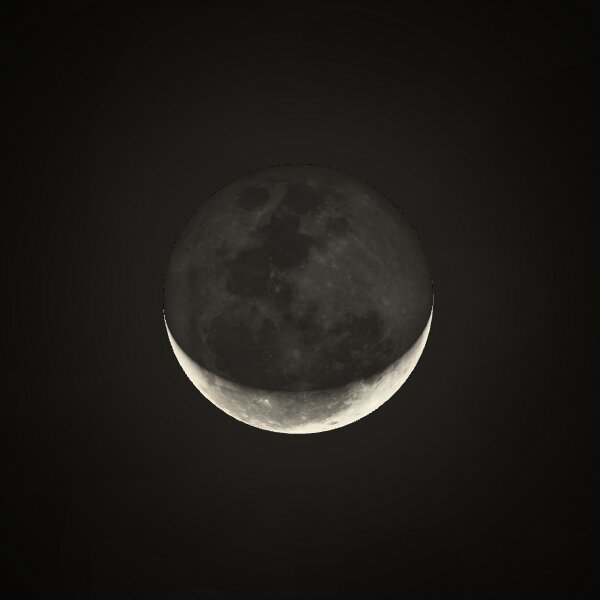
The smile over the Congo, 30 July 2016
Why the Moon smiled
A crescent’s lit side always faces the Sun, and just before dawn the Sun is hiding below the horizon. In London it climbs out at a slant, so the crescent leans over on its side. Near the equator the Sun comes straight up from below, so the lit side points straight down, and the crescent sits there smiling.
Here it is in the planetarium. These links take you to the same moment, about 04:30 in the morning on 30 July 2016 (my best guess at when i crossed the equator):
- The Moon from the equator, over the Congo: a smile.
- The same Moon from Heathrow: tipped over on its side.
The Sun going backwards has a simple answer too. From the northern half of the world you face south to see the Sun, and it goes from left to right. In Johannesburg it’s in the north, so you face the other way, and it goes from right to left. Here’s 10am in Johannesburg: speed the time up and watch it. When i do, i really try to imagine where i am on the giant ball that is our planet, and picture the globe turning with me on it while the Sun stays still. The Sun only seems to go the other way because i’m facing the other way.
And the new stars? Most of them were just stars i’d never been far enough south to see. The Southern Cross was high in the south-west. Since then the planetarium has shown me what i missed: Orion is there too, but it’s on summer evenings, in December, not in July. It made me laugh when i saw Orion upside down in the planetarium.
The sky from where you stand
The planetarium started as a basic sky: the Sun, the Moon, the planets and the stars where they really are, for any place and any time. Then came Point at sky: hold your phone up and the sky on the screen follows it. Tap a star and find out what it is.
At first the ground was a flat line. When i added the real hills and mountains, plus the sea, lakes and rivers, something clicked. With real land under it, you could see the sky turning round the Earth, with the Sun setting behind the actual hill and not just a line.
Then i wanted names on the peaks. Then towns, towers, lighthouses and observatories (it is a planetarium, after all). That’s where i hit the limits of OpenStreetMap’s public servers. They’re run by volunteers, they’re often busy, and on a bad afternoon you got no names at all. So i built a little side project, planetarium-labels: the names of the whole world cut into small squares, so the planetarium loads just what it needs, reliably. It deserves a more technical post of its own, which is coming later.
One sky, all the way up
It was important to me that it should all feel like one place. Whether you’re standing in your garden, lifting off above it, riding a satellite or standing on the Moon, it’s the same sky with the same stars, in the same places.
So when you press Lift off, there’s no cut to a separate “space” scene. You rise straight up, the land falls away, the sky turns black, and the stars stay exactly where they were. Then the view slowly tips down and there’s the whole Earth below you, with the day and night line, city lights on the dark side, and the orbits of the Moon and the planets drawn round you in 3D.
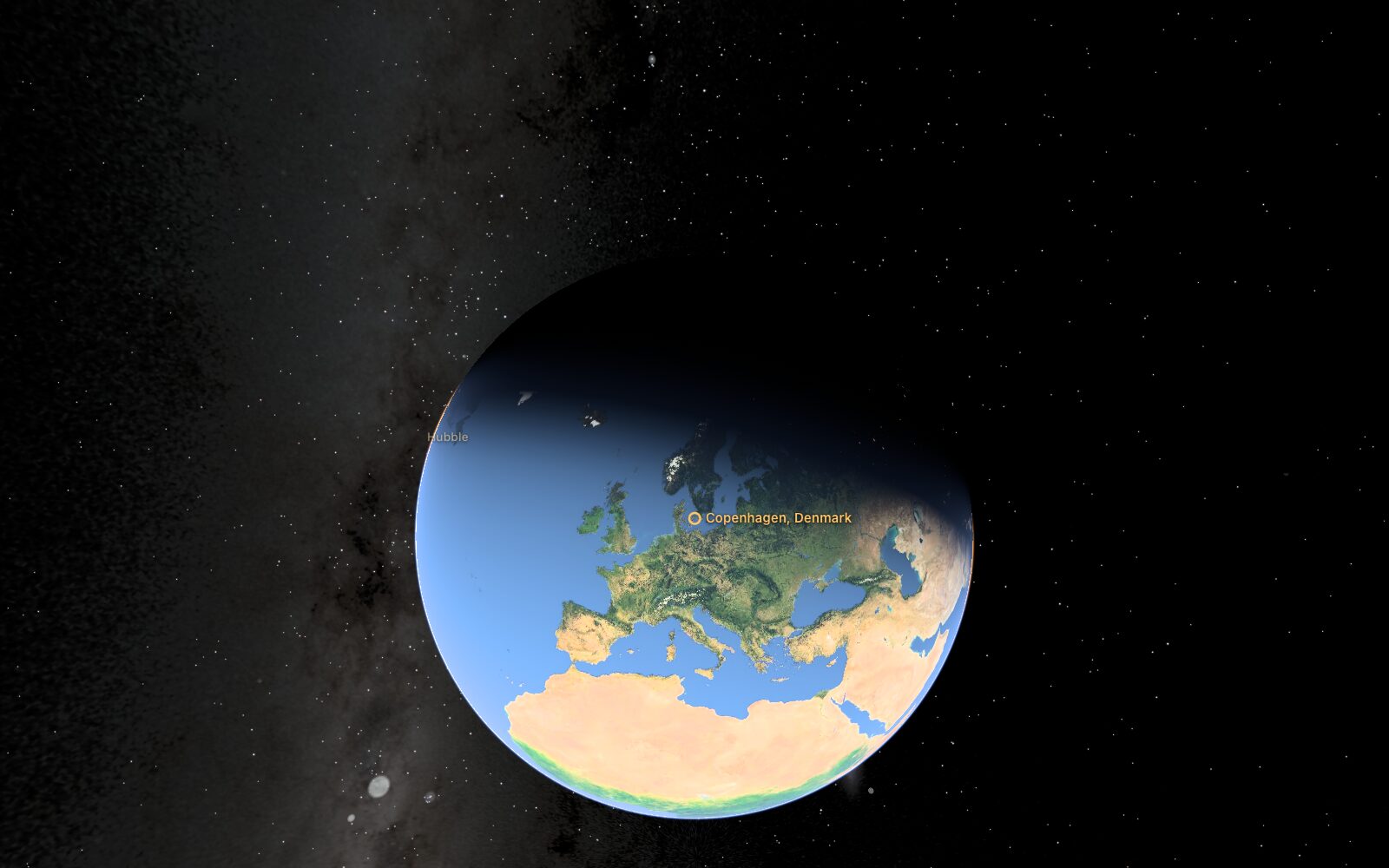
6,000 km above Copenhagen
This gave me a much better feel for sizes and distances than diagrams ever had. The Moon’s orbit is enormous next to the Earth, and the planets are out there along their own paths. From the ground i’m looking out sideways across them all.
Time mattered too. Wherever you go, the clock keeps going as it was, so it always answers the question, “if i were there right now, what would i see?” That meant allowing faster-than-light travel. I didn’t want to say “off to Jupiter” and then sit there for 42 minutes at the speed of light. When we do go to Jupiter, i want us to zoom straight there and see it as it is right now.
And of course, the planetarium had to have Pluto and Charon. I’m old enough to remember when Pluto was still a planet, and it’s always been a little bit sad to me that it got demoted. I’ve always been fond of the pair of them. I once did a cover of Jonathan Coulton’s “I’m Your Moon”, sung by Charon to Pluto.
Things i didn’t know i’d learn
Lots of little things surprised me along the way:
- Jupiter’s moons cast shadows that aren’t under them. The shadow points straight away from the Sun, but we look from a little off to one side, so the shadow lands a little way from the moon. Here’s Io with its shadow ahead of it. After the Earth passes between the Sun and Jupiter, it’s the other way round.
- Some of Jupiter’s moons are a very long way out. Himalia and Elara are around 11 million km from Jupiter, nearly 30 times as far out as our Moon is from us. Out there the Sun tugs on them a lot, and their orbits are quite elliptical.
- Uranus is on its side, and right now it’s facing us. Its moons go round its middle, so at the moment we see their orbits nearly face-on, like a target.
- The Earth’s spin is a nuisance for telescopes. Zoom in on Jupiter from the ground and it slides off the screen in under half a minute. That’s why telescopes have motors to follow the stars. Press Lift off instead and you hover in one spot while the Earth turns beneath you, so Jupiter stays put.
- The Earth’s phases from the Moon go the opposite way to the Moon’s phases from here. When we have a new Moon, the Moon has a full Earth.
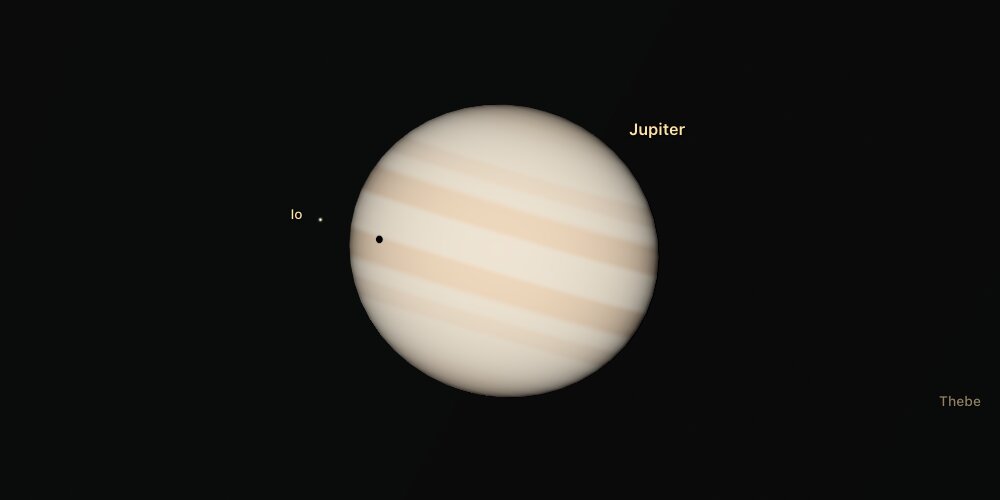
Io and its shadow on Jupiter
What the air and the city lights hide
The planetarium only shows what you could really see. Every star is checked against how bright the sky is right behind it, so the Moon, the twilight, the air you’re looking through and the glow of the towns around you all decide what shows.
It makes more difference than i’d realised. At new Moon the sky is full of faint stars and the Milky Way. At full Moon you’re left with a few hundred. Low down you’re looking through up to 40 times as much air as straight up, so the stars fade and redden. Then there’s the glow of the city. From the middle of Copenhagen you can’t see the Orion Nebula at all, because of the light pollution. Go to Møns Klint, Denmark’s dark sky park, on the same night, and there it is: a misty patch in Orion’s sword.
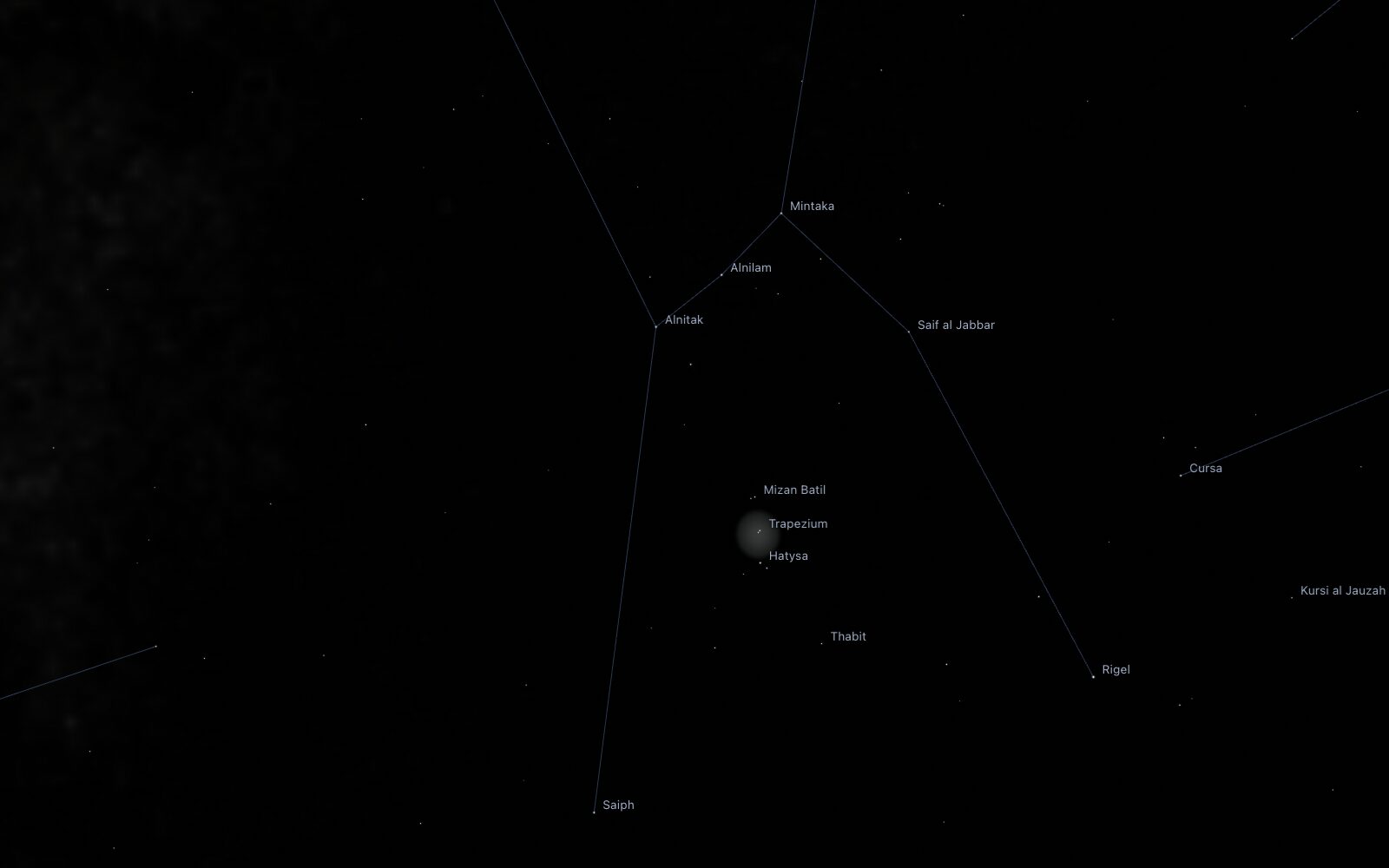
The Orion Nebula from Møns Klint
Turn off the Atmosphere layer and you see the sky as it is from space: the Sun shining in a black sky full of stars.
The first time i knowingly saw Saturn
All of that paid off one evening this November. About an hour after sunset in Copenhagen i saw a bright point low in the south-east, held my phone up with Point at sky on, and there was only one thing in that direction: Saturn. It looked golden.
I don’t think i’d ever knowingly seen Saturn before. And it worked because the planetarium doesn’t show every star all the time. In the twilight, with the city’s lights and the haze low down, the faint stars weren’t out yet, so there was nothing else it could be.
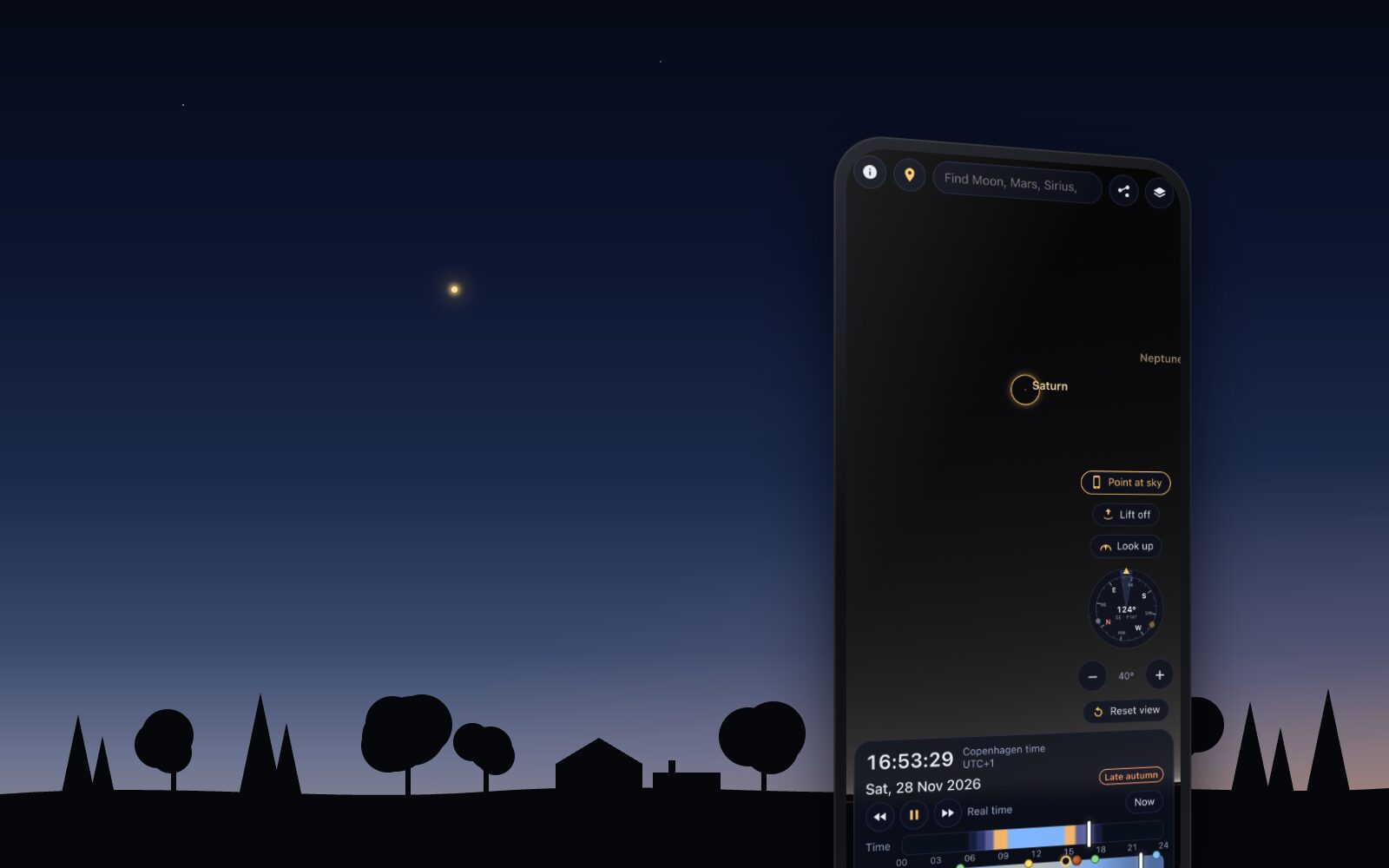
A recreation of that evening
There’s no such thing as “up”
This is probably the biggest thing it’s taught me. On the ground, up is up and north is north. Out there they’re just directions, and the Earth can be any way round.
From the Moon, speed up time and the Earth spins in the sky “upside down”, or on its side. It isn’t doing anything strange: that’s just how it looks from where you are.
Then i added the International Space Station. You can watch it glide over from the ground, and the planetarium lists the passes you’ll be able to see. Or you can press Go there and ride along with it, about 420 km up, going round the Earth every 93 minutes with the world turning beneath you. When i first tried it, i came in over Japan at an angle i never expected. On a map Japan always sits the same way up, but from the ISS it comes over the horizon however the orbit happens to cross it that time round.
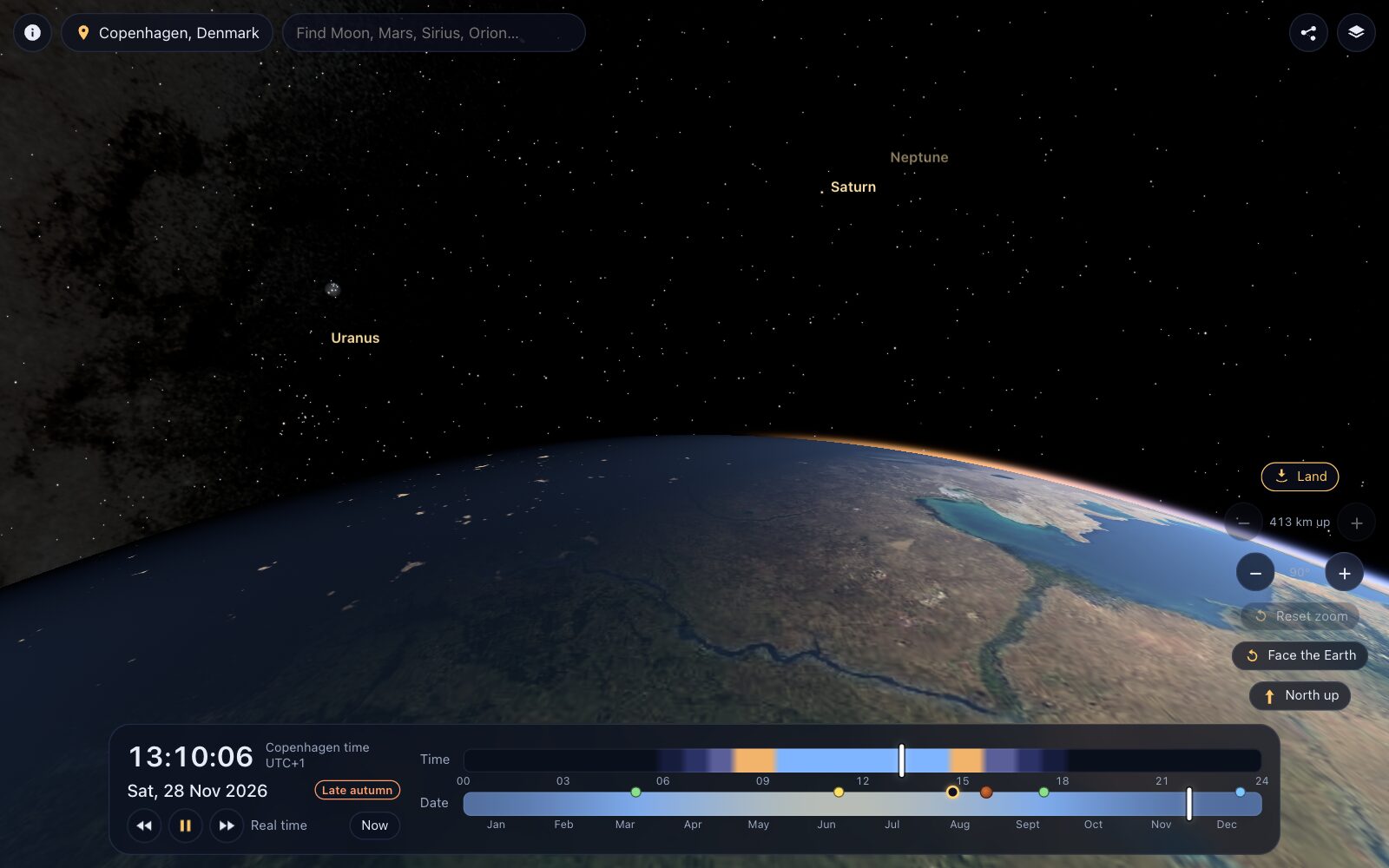
Riding the ISS over southern Russia
Turn the view round so the Earth is above you and something else clicks. You get the sense that you’re falling, all the time, and just missing. That’s what Newton described with a cannonball: fire it fast enough and the ground curves away beneath it as fast as it falls, so it never lands. That’s an orbit.
Going to the Moon
The Moon’s card has a Go there button. You lift off, glide across in a few seconds and land at the spot nearest to where you were, where the Earth hangs almost straight overhead. It stays there all month, nearly four times as wide as the Moon looks from home.
I was surprised by how slowly the sky turns on the Moon. It makes sense, though: the Moon always keeps the same face towards the Earth, so it only turns once a month. That’s two weeks of sunshine, then two weeks of night.
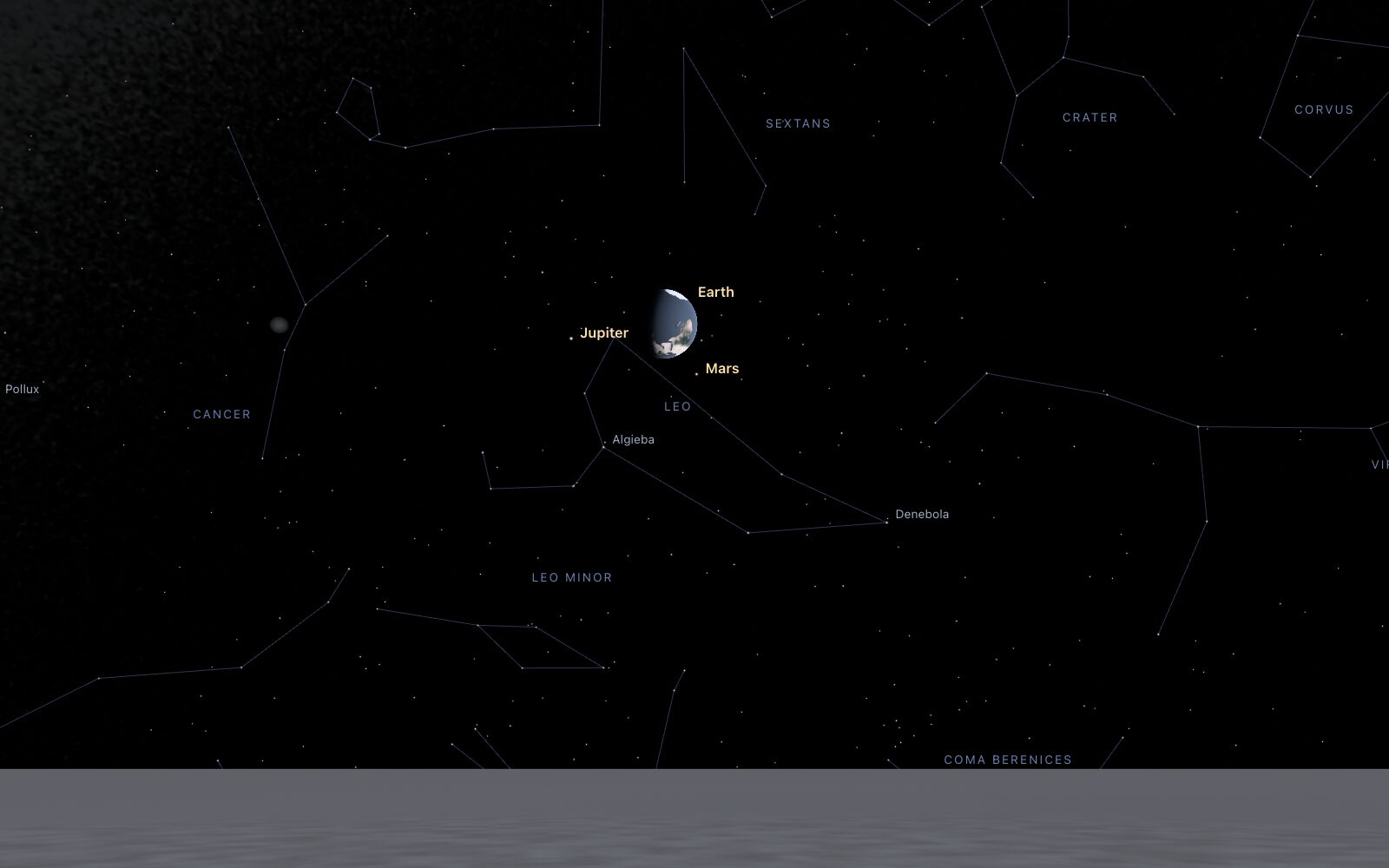
The Earth from Clavius
I was watching 2001: A Space Odyssey while building this, and it turned out to be the perfect companion. When they flew to Clavius, and dug up the monolith in Tycho, i was excited to learn they’re real places, both marked on the planetarium’s map of the Moon. Here’s the Earth from Clavius.
Little facts everywhere
It’s easy to jump around. Every card links to the next thing, so you can go from a planet to its moons, to a crater, to a galaxy, and the back arrow takes you home again. And every card has something to know about it.
Some of them connect the light to history. Pollux’s light set off 33.8 years ago, in 1993, three years after the Hubble Space Telescope was launched. (1993 being 33.8 years ago came as a bit of a shock!) The Andromeda Galaxy’s light set off about 2.5 million years ago, when our ancestors were already making stone tools, but long before our own species existed.
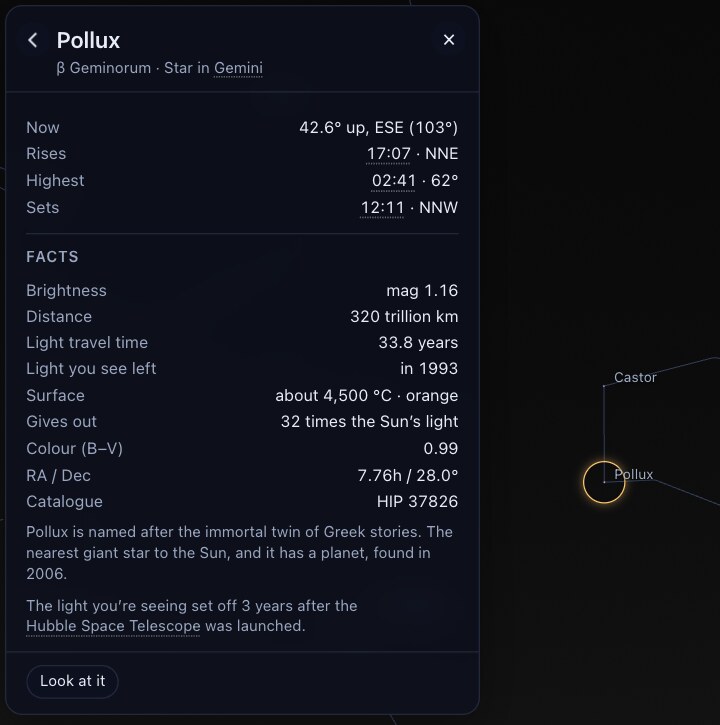
Pollux and its card
A few others:
- Betelgeuse will one day blow up as a supernova, maybe within the next 100,000 years. It’s about 500 light-years away, so i always hope it blew up around 500 years ago, and that the light is nearly here.
- Enceladus, one of Saturn’s moons, is spraying fresh snow out of its south pole all the time.
- Europa, one of Jupiter’s, has a salty ocean under its ice with more water than all the Earth’s seas: one of the best places to look for life beyond the Earth.
Matching a photo from Tromsø
This November i went to Tromsø for Arctic Pride. I was fascinated by the short days. It amused me that the 2pm start of the pride parade was after sunset!
That morning i’d gone down to Sydspissen, the south tip of Tromsøya (the island the town is on), to catch a glimpse of the Sun, which was hidden behind the mountains from the town itself. Back home i pasted the exact spot where i’d stood into the planetarium, and there it was: at 11am the Sun was only a couple of degrees up, nearly as high as it would get that day, sitting between the mountains just as i’d seen it.
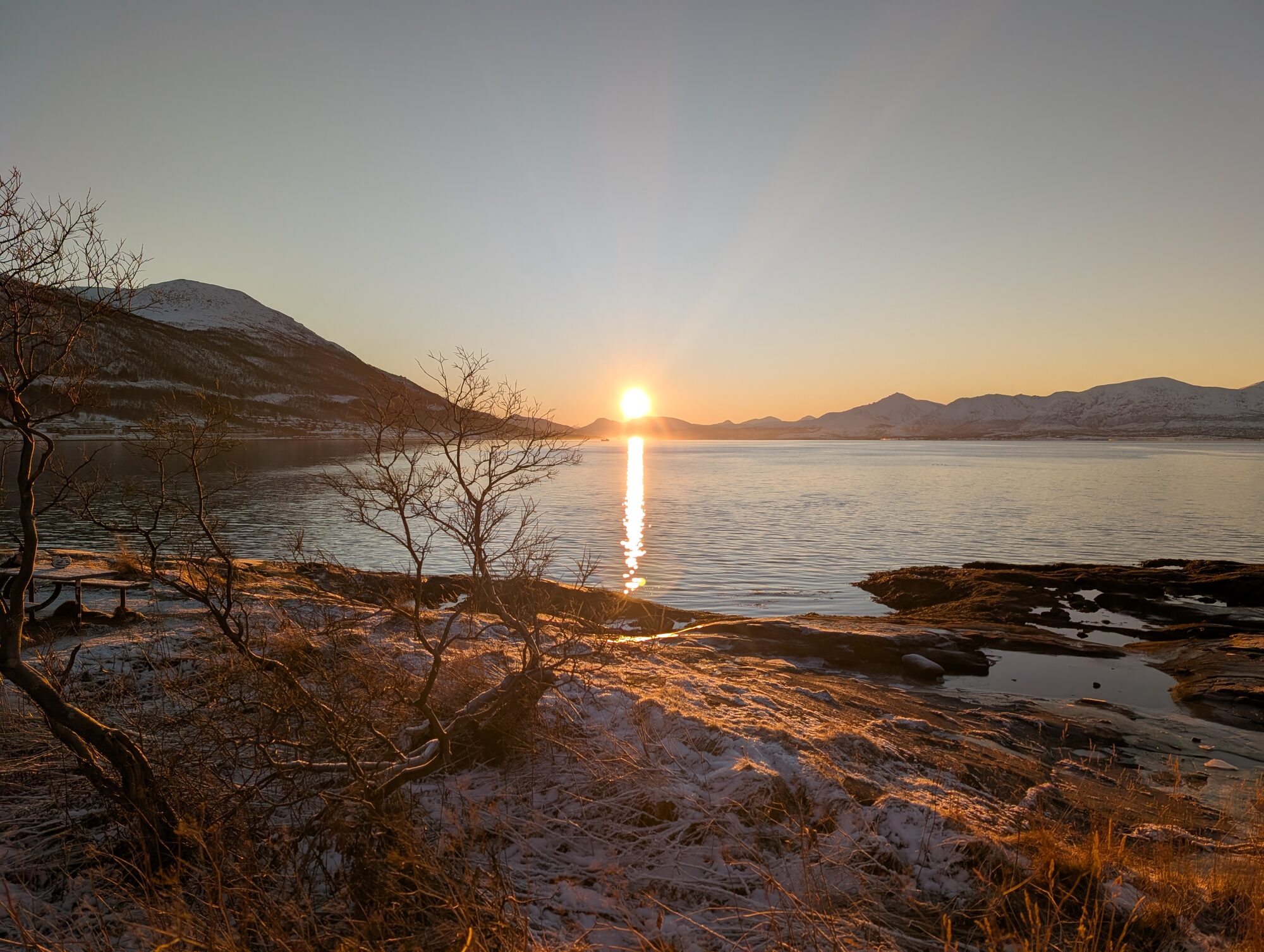
Sydspissen, Tromsø, at 11am on 14 November
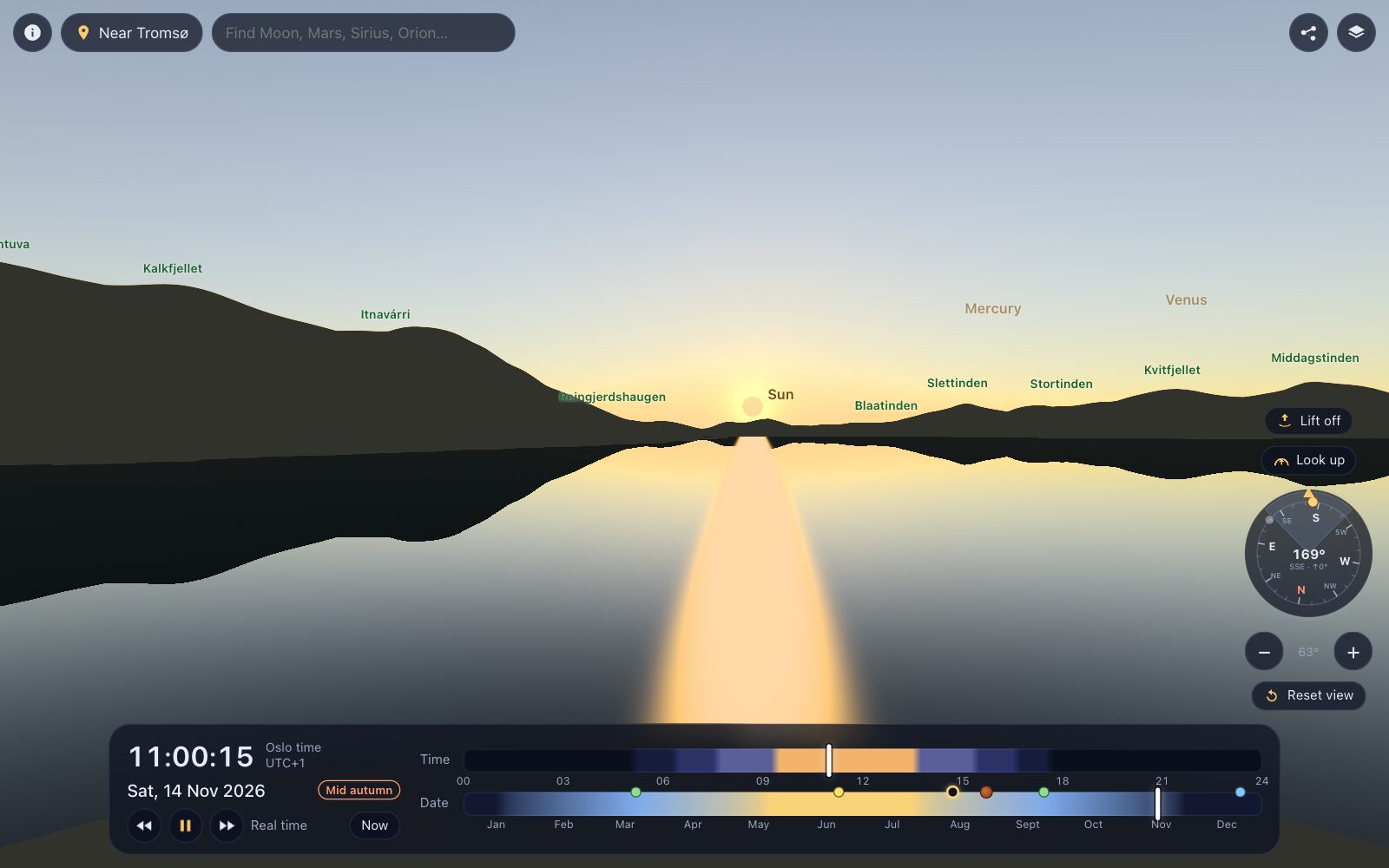
The same moment in the planetarium
Built in a week
I started working on the planetarium on Sunday 22 November. Over lunch my friend André asked, “What’s your next project? You’re always working on something!” I told him about the planetarium idea, and he said, “Let’s make it this afternoon!” He started off helping me, then decided he wanted to build his own, in a totally different creative direction. By the end of the afternoon i had the first working prototype, and this post is going up a week later.
I built it with Claude Code, and i’m still utterly gobsmacked by that. If someone had told me two years ago that i’d build a working model of the solar system in a week, i’d have laughed and said that was impossible. I brought the questions, the ideas and the testing outside in the cold, and Claude Code did the orbital maths, on top of Don Cross’s Astronomy Engine, which had already done a lot of the hard work.
Try it
- Open druewilding.com/planetarium on your phone and add it to your home screen. It works offline too.
- Turn on Point at sky, hold the phone up and tap whatever you’re looking at.
- Some browsers block motion sensors by default. If the sky doesn’t move with your phone, allow motion sensors in the site settings.
What would you look for first?
What’s next
So far you can stand on the Earth and the Moon. Next i want to go further: to the other planets and their moons, to jump between worlds and see how the solar system looks from each of them.
And i’m looking forward to flying to Jupiter and finding out if its moons really look the way they do in 2001: A Space Odyssey.